
Home » Products » Product Categories » Other Products » Reach Forklift with Vacuum Attachment
Reach Forklift with Vacuum Attachment
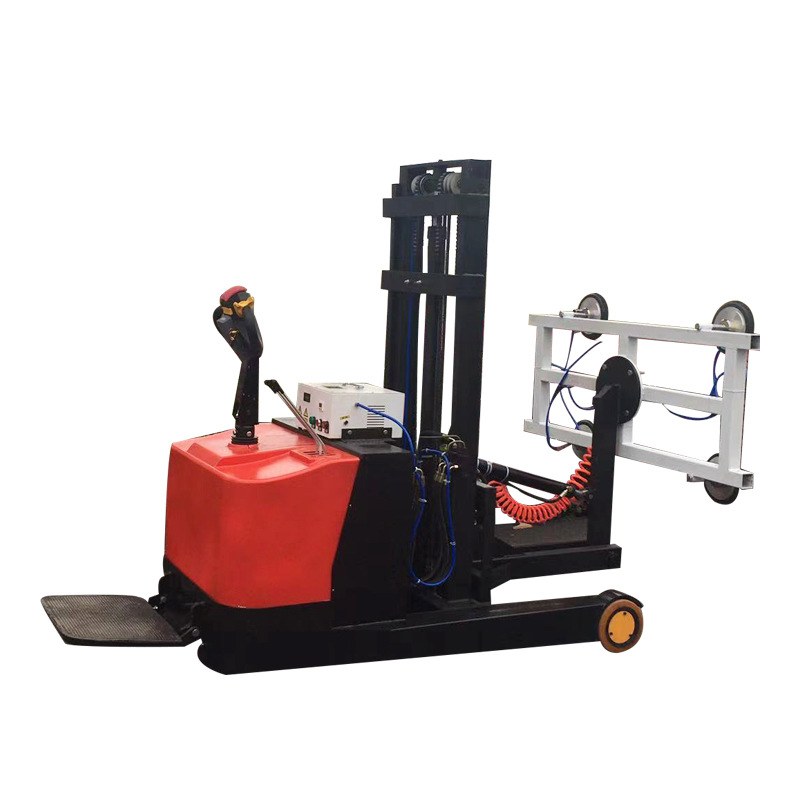
Overview
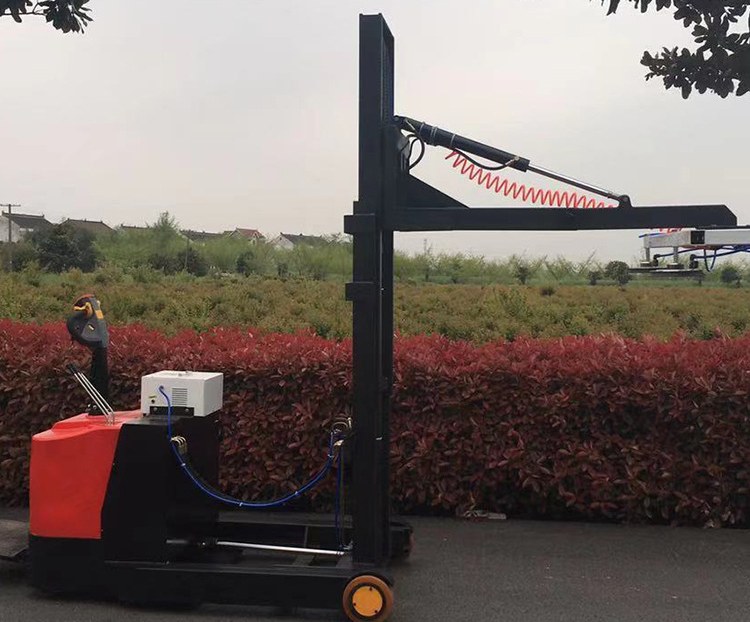
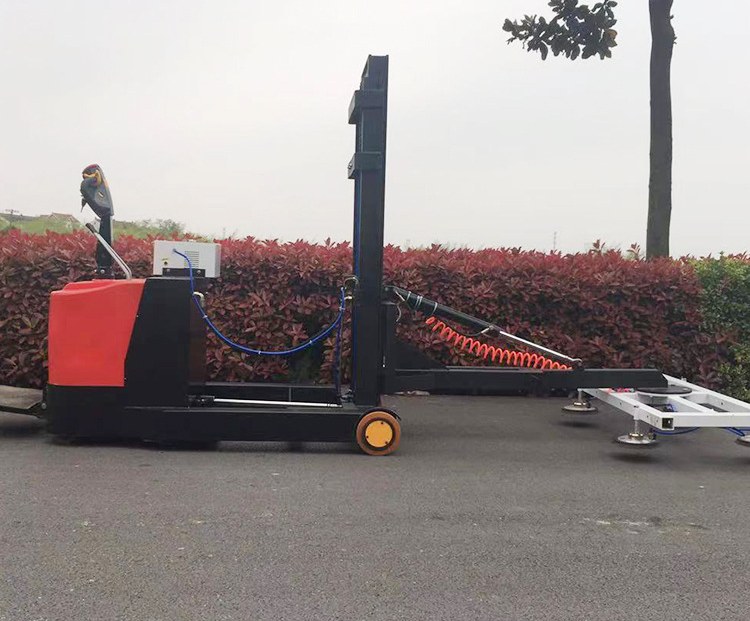
A reach forklift is a stand-on electric stacker with a forward-reach mast. This version carries a vacuum attachment instead of forks: the operator stands on the platform, steers with the tiller, runs the mast up and extends the cup frame to the face of the sheet. Once the cups have sealed, the panel travels on the machine.
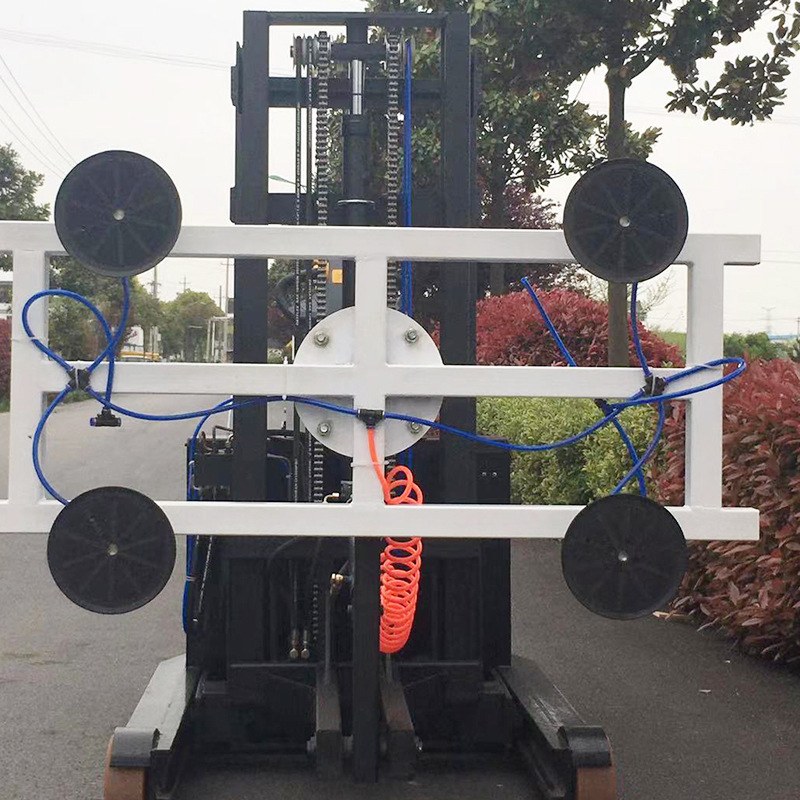
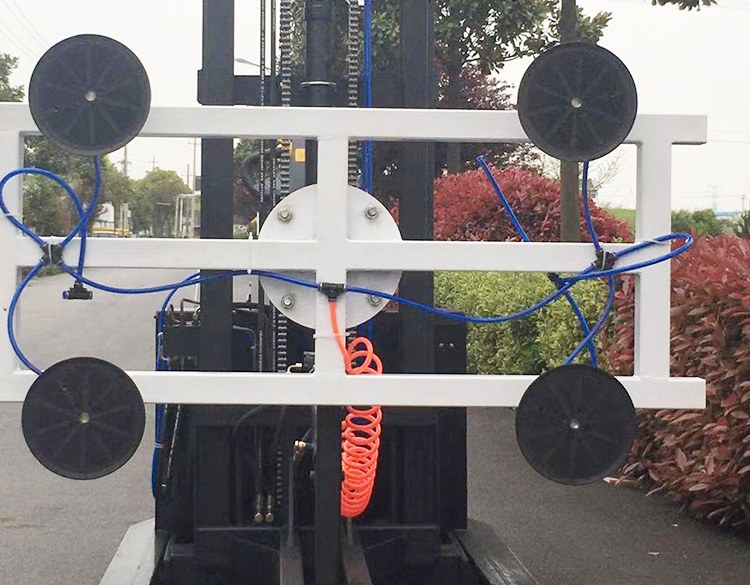
The attachment is a four-cup frame on a steel tube carrier. Because the cups grip the face of the material rather than hooking under it, a sheet can be lifted off a stack, carried through a doorway and set down again without anything touching its edges. It is the same holding principle as our other vacuum lifters, mounted on a self-propelled chassis.
That combination suits sites where a crane cannot reach. There is no sling to fit, no lifting plan to write and no second pair of hands needed for a single panel, so a glazing or stone job can move at the pace of one operator and a charged battery.
Key Features
- Forward-reach mast: the carriage extends the cup frame out to the load, so the stacker itself does not have to be driven against the stack
- Four-cup vacuum frame on a welded steel tube carrier
- Powered lift and lower from the tiller, with controllable lowering speed
- Stand-on platform, foot pedal and rubber-coated handle for a stable working position
- Battery electric drive: no air line, no trailing cable and no hydraulic take-off
- Chain-lift mast in C-section steel
- Non-marking cups: polished glass, coated panel and finished stone come off the frame as they went on
- Also used on metal: the cups hold any flat, gas-tight surface, so sheet steel and aluminium plate work as well as glass
- Compact footprint for workshop aisles and standard doorways
- Available as 1.5 t and 2 t stackers, with the attachment sized to your panel
How the attachment carries a sheet
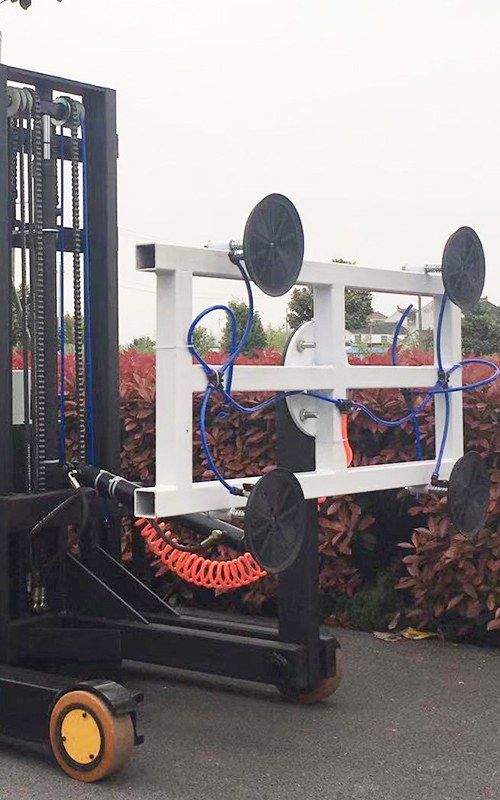
The white frame on the front of the mast is a carrier, not a forklift carriage. Four suction cups sit at the corners of the frame and are plumbed to a central manifold on the back of it with flexible hoses, so the frame can be extended and tilted without straining the vacuum circuit.
A sheet is picked up flat and carried flat, which means there is no edge contact anywhere: the load hangs on the face of the panel, which is why the finish survives the trip across the yard.
Holding the sheet on the face of the frame instead of balancing it on tines keeps the load close to the mast, so the machine stays stable in a narrow aisle and the operator can see past it.
Specifications
| Item | Detail |
|---|---|
| Machine type | Stand-on electric reach stacker with vacuum attachment |
| Stacker capacities available | 1.5 t and 2 t |
| Steering | Tiller handle with stand-on platform and foot pedal |
| Mast | Forward-reach, chain lift |
| Vacuum attachment | Four-cup frame on a steel tube carrier |
| Suction cups | 4, non-marking |
| Vacuum circuit | On board, flexible hoses to a central manifold |
| Drive | Battery electric |
| Materials | Glass, stone and metal sheet |
The 1.5 t and 2 t figures are the rated lift of the stacker. What a sheet needs is the right cup frame, so tell us the panel sizes and weights and we will match the attachment to the machine.
Other Specifications
- Non-marking cups leave no scratches, indentations or abrasion marks
- Holds by sealing, so the panel face must be smooth, dry and non-porous
- Dusty, wet, oily or porous faces cannot be relied on to hold
- Mast chain and wheels need the usual workshop maintenance
- Attachment can be configured for glass, stone or metal sheet
- Battery is charged from a standard mains supply
These are the standard configurations, not the limit of what we build. Cup quantity and diameter, frame size, mast height, stacker capacity and control arrangement can all be adapted to the material you handle.
Send us the sheet sizes, the weights and a photograph of the site, and we will come back with a build that fits rather than the nearest catalogue number.
Where it is used
- Glass processing: moving sheets between the rack, the cutting or tempering line and the finished-goods store
- Curtain wall and glazing: carrying a panel from the delivery stack to the opening
- Stone yards: lifting and transferring slabs without edge clamps
- Metal fabrication: handling sheet steel and aluminium plate without marks
- Workshop aisles and doorways a crane cannot reach
- Loading and unloading flat material from racks, trucks and containers
Tell us the panel sizes, the weights and the aisle you work in, and Vera Yang will confirm the stacker and attachment that fit.
Request a Quotation