
H-Frame Glass Vacuum Lifter
Overview
H-frame glass vacuum lifters move large glass from 800 kg up to 3,000 kg — flat into vertical racks, over machinery and into curtain-wall positions — with electric flip and electric rotation for precise placement by one operator.
Models & Options
- 800 / 1,000 / 1,200 kg — electric flip (tilting) and electric rotation
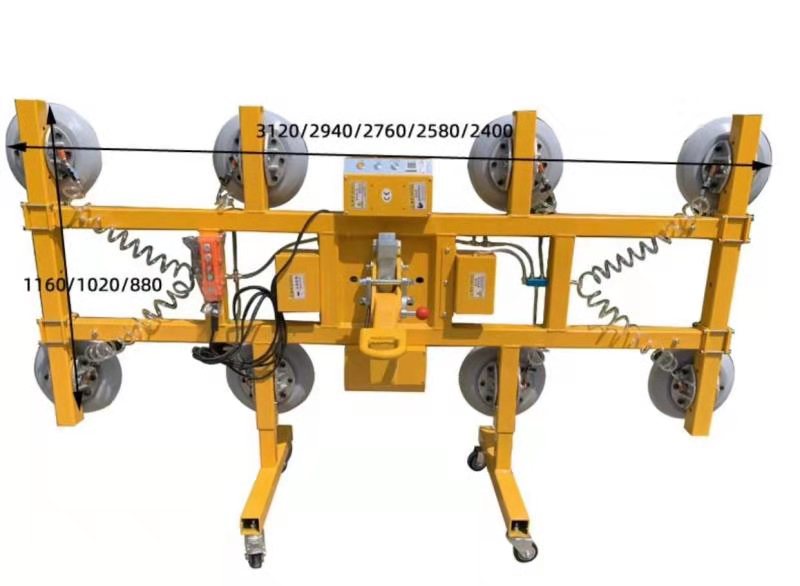
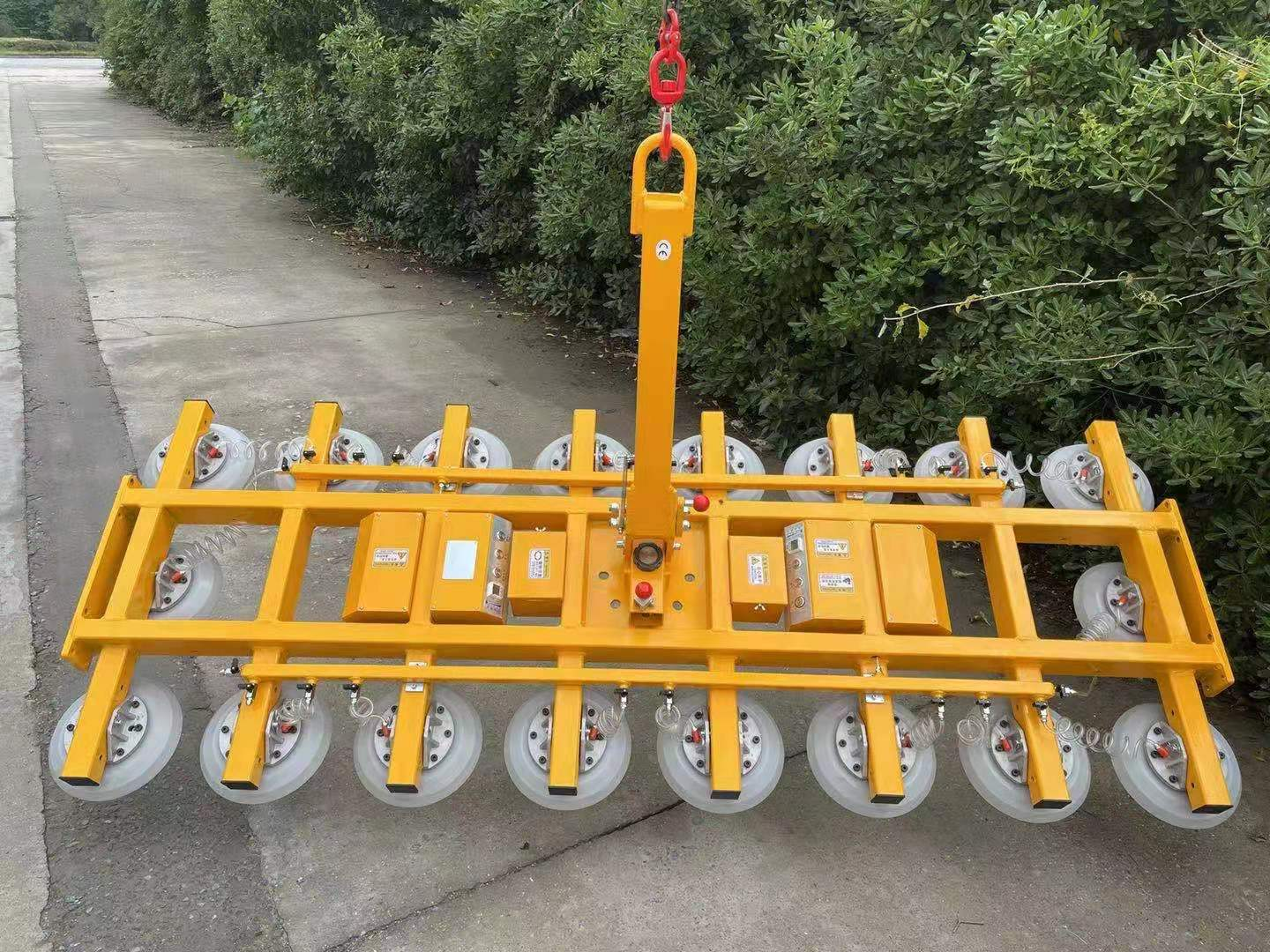
- 1,500 kg dual-system version, 18 suction pads — standard rotation; main frame 3 m × 1.02 m; optional auxiliary frames 1 m × 1.02 m (two pieces) to widen the span
- 1,600 kg — standard rotation
- 2,000 kg — electric rotation and hydraulic flip
- 3,000 kg — electric rotation and hydraulic flip
Safety & Build
- All-enclosed Q345 manganese-steel welded frame, durable coating
- American THOMAS DC vacuum pump and maintenance-free battery — no external air or power
- Panasonic digital vacuum-pressure display and battery gauge
- Automatic vacuum refill keeps constant safe pressure while glass is in the air
- Power-loss hold with alarm, plus spare 12 V battery
How the H-frame carries a panel
A suction frame in an H layout is built from beams joined by a cross member, with the pads mounted along those beams rather than grouped at the corners of a single square. On a long or wide sheet that arrangement supports the panel at several points across its width, so the weight is shared instead of concentrated under a few pads. It is also what allows the frame to be widened: auxiliary frames bolt on to the main beam when a job calls for a larger span.
On thin or large-format panels this matters more than the headline capacity. A sheet that flexes under its own weight can crack where two supports sit far apart, and it is harder to slide into a rack or an opening if it is bowing in the middle. Spreading the support keeps the panel closer to flat on the way up and while it is being positioned.
How the load is held
The pads have a soft, elastic contact face. On polished glass, coated panel and finished stone they leave no scratches, indentations or abrasion marks, so the surface arrives at the installation as it left the workshop, with no polishing afterwards.
What holds the panel is not one grip but the sum of the pads. Each pad shares the load, which spreads the force across the face of the sheet and avoids the local stress concentration that can start a crack in a large or thin panel.
Three conditions have to be met before a lift: the panel face has to be smooth, dry and non-porous; the pads have to be clean and undamaged; and the weight of the pack has to sit inside the rated capacity of the frame. A vacuum lifter holds by sealing, so a dusty, wet, oily or porous surface is the one thing it cannot be relied on for.
Where the head can be mounted
The head is suspended rather than mounted on a mast. It hangs from an overhead crane, a wall or column jib, a gantry, or a boom carried by a forklift, and the flip and rotation movements are built into the suspension, so a panel can be taken flat off a rack, brought upright and turned to the angle the opening calls for.
Because the working position is set by the crane or jib rather than by the machine itself, the same head covers both a fixed bay and an open site: feeding a cutting or tempering line, lifting slabs on and off a rack, or carrying a panel from the delivery stack to the point where it is fixed.
Materials and typical work
Any flat, non-porous material that a pad can seal against is a candidate. In practice that covers glass, insulating glass units and laminated glass; marble, granite, quartz and other stone slabs; cement board, artificial stone and large-format ceramic; and metal sheet and composite panel where the face must not be marked.
- Glass processing: moving sheets between the rack, the cutting or tempering line and the finished-goods store
- Curtain wall and facade work: taking a panel from the delivery stack to the opening and holding it at the installation angle
- Stone yards: unstacking, transferring and restacking slabs, including thin large-format material
- Machine feeding: placing a sheet onto a laser, waterjet or processing table
- Logistics and warehousing: loading and unloading flat panels from containers, trucks and racking
Before you order
Capacity is only one of the numbers that decides the build. The frame and pad layout follow the panel size, the pack weight decides the model, and the height the panel has to reach decides whether an auxiliary frame or a different suspension is needed. Send us the panel sizes, the panel weight and a photograph of the pick-up and installation points, and we will confirm the configuration that fits instead of quoting a catalogue number.